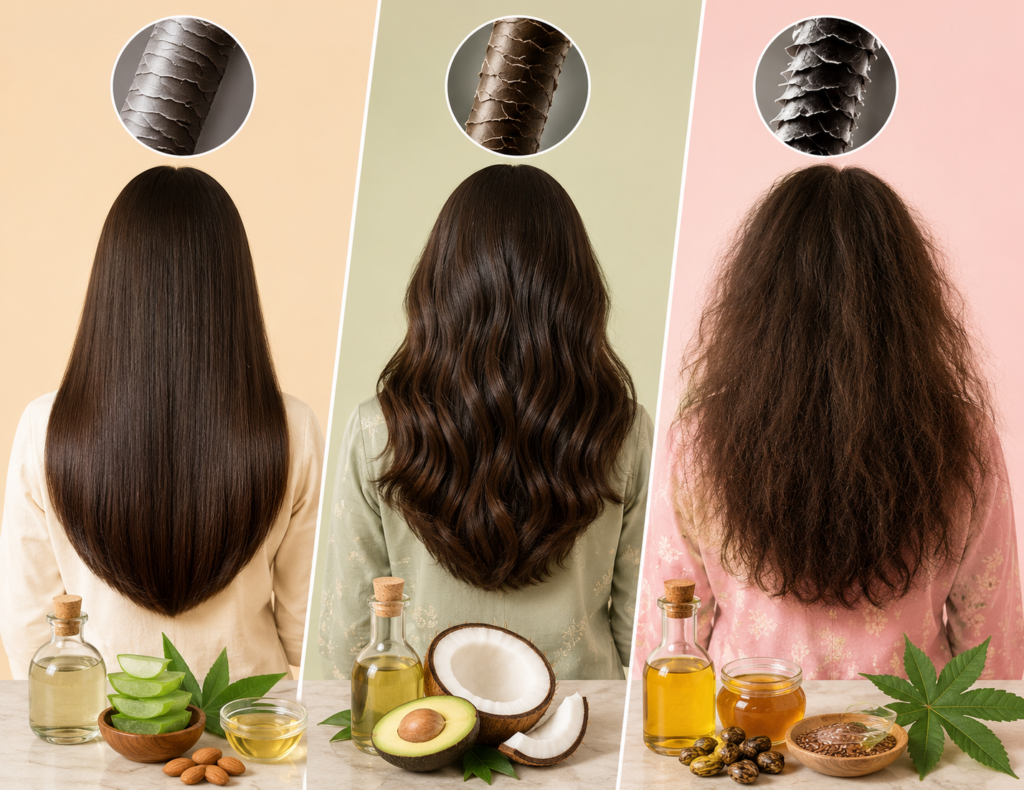
Quick Answer: Hair porosity describes how well your hair absorbs and retains moisture. Pakistani hair types commonly fall into low porosity (resistant to oils, prone to buildup) or high porosity (damaged, frizzy, quick to dry). Knowing your porosity type lets you choose oils and routines that actually work for desi hair instead of wasting money on products your cuticle cannot process.
You spent PKR 1,200 on that hair oil your favourite influencer swore by. You applied it twice a week, wrapped your hair in a warm towel, and waited for the miracle. Two weeks later, your scalp is an oil slick, your ends are snapping off, and your bathroom mirror shows the same frizzy halo it always has. You wonder if the product is fake, if your water is bad, or if you are simply cursed with bad hair. The real answer is probably simpler: you do not know your hair’s porosity, so you are feeding it the wrong things. Hair porosity is not a buzzword invented by foreign bloggers. It is the single most useful diagnostic for understanding why your hair behaves the way it does, and it matters enormously for Pakistani women dealing with hard water, heat styling, and hijab friction.
What Is Hair Porosity?
Hair porosity is your hair’s ability to absorb and retain moisture and oils. It is determined by the condition of the cuticle, the outer protective layer of the hair shaft. Think of the cuticle like the scales on a fish. When those scales lie flat and tight, moisture and product sit on top rather than sinking in. When they are lifted or damaged, moisture enters easily but escapes just as fast. Your porosity is largely genetic, though chemical treatments, heat damage, and environmental stress can alter it over time. Understanding this one characteristic explains more about your bad hair days than any shampoo commercial ever will.
The Three Types of Hair Porosity
Most Pakistani women fall into one of three categories. Knowing which one describes your hair changes everything about how you oil, wash, and protect it.
Low porosity means your cuticle layers are tightly packed. Your hair takes forever to get wet in the shower and equally long to air dry. Products tend to sit on top rather than absorb, leading to buildup and that greasy-yet-dry paradox where your scalp is oily but your ends are straw.
Medium porosity is the balanced middle ground. Your hair absorbs moisture at a reasonable rate and retains it without excessive frizz. It holds styles well and does not complain too much unless you abuse it with constant heat or bleach.
High porosity means your cuticle is lifted, chipped, or missing in places. Your hair soaks up oil and conditioner instantly but feels dry and rough again within hours. It tangles in the wind, frizzes in humidity, and snaps when you brush it wet.
| Porosity Type | How It Feels | Drying Time | Product Reaction | Common in Pakistani Hair |
|---|---|---|---|---|
| Low | Smooth, product-resistant | Very slow | Buildup, greasiness | Yes — especially with hard water mineral coating |
| Medium | Balanced, manageable | Moderate | Absorbs normally | Less common in adults with heat/chemical history |
| High | Rough, tangly, frizzy | Very fast | Soaks up then dries out | Yes — heat styling, rebonding, hijab friction |
How to Test Your Hair Porosity at Home
You do not need a laboratory. You need a glass of water and five minutes.
The float test. Take a clean, shed hair strand and drop it into a glass of room-temperature water. Wait four minutes. If the hair floats, you have low porosity. If it sinks slowly, you have medium porosity. If it drops immediately, you have high porosity. Do this after washing your hair with a clarifying shampoo, not after an oiling session, or the oil will skew the result.
The spray test. Mist a small section of dry hair with water. If the water beads up and rolls off, your cuticle is tight — low porosity. If it absorbs within a few seconds, you are medium to high.
The strand slide. Run your fingers up a single hair strand from end to root. If it feels smooth and slippery, the cuticle is flat (low porosity). If it feels bumpy or rough, the cuticle is lifted (high porosity).
One warning: if you live in an area with hard water — which is most of urban Punjab and Sindh — mineral buildup can coat your strands and temporarily mimic low porosity even if your hair is naturally more absorbent. Clarify with a chelating shampoo or a simple apple cider vinegar rinse before testing.
Why Pakistani Hair Types Face Unique Porosity Challenges
Pakistani hair is typically thick, wavy to curly, and coarse in texture. This hair type is naturally more prone to dryness at the ends because scalp oils struggle to travel down a curved shaft. Add hard water calcium deposits that seal the cuticle shut, and you get widespread low-porosity behaviour: oily roots, dry ends, and product that seems to do nothing.
On the other end, high porosity is often self-inflicted. Rebonding treatments, frequent blow-drying for weddings, and the friction of synthetic hijab caps rubbing against the crown all lift the cuticle. Karachi’s sea humidity makes high porosity hair frizz dramatically. Islamabad’s dry winter air pulls moisture from damaged cuticles overnight. Your environment is not neutral. It is actively negotiating with your hair every day.
Low Porosity Hair: What Works
If your hair repels oil and takes hours to dry, you need lightweight products and heat to open the cuticle temporarily.
Use lightweight oils like sweet almond or argan rather than heavy mustard or solid coconut oil, which sit on the surface and attract dust in Pakistani traffic. Apply oil to hair that is damp, not soaking wet, and wrap a warm towel around your head for fifteen minutes to lift the cuticle slightly. Clarify regularly — once every two weeks — to remove hard water buildup that blocks absorption entirely. Avoid protein-heavy conditioners; your hair does not need more structure. It needs moisture that can actually enter.
For specific oil recommendations tailored to desi hair, read our guide on home remedies for hair growth oil.
High Porosity Hair: Repair and Maintenance
If your hair drinks oil instantly but feels like straw by evening, you need heavier sealing and damage control.
Use thicker oils like castor or avocado, and layer them over a water-based leave-in. Consider occasional protein treatments — once a month, not weekly — to patch damaged cuticles. Avoid high heat entirely for at least three months to let the cuticle lay flat again. Sleep on a silk or satin pillowcase to reduce friction, and never brush your hair when it is wet and vulnerable. Acidic rinses, like a tablespoon of apple cider vinegar in one cup of water, help smooth the cuticle after washing in hard water areas.
Medium Porosity: Keep It Simple
If you are lucky enough to have medium porosity, your job is maintenance, not repair. Use a balanced shampoo and conditioner cycle. Deep condition once a month. Do not overload with protein or heavy oils just because social media tells you to. Your hair is already doing what it should. Leave it alone before you accidentally damage it
Common Mistakes That Worsen Porosity Problems
The most damaging mistake is using coconut oil indiscriminately. Coconut oil is excellent for high porosity hair that needs sealing, but on low porosity hair in hard water areas, it creates a waxy buildup that repels moisture even more. If your hair feels stiff after oiling, coconut is not your friend.
Another error is assuming porosity is fixed. While your baseline is genetic, repeated rebonding or neglect can push medium hair into high porosity within a single wedding season. Pay attention to changes.
A third mistake is confusing porosity with density. Thick hair can be low porosity. Fine hair can be high porosity. Do not buy products based on how much hair you have. Buy them based on how your cuticle behaves.
Frequently Asked Questions
Can hair porosity change over time?
Your genetic baseline stays the same, but damage from chemicals, heat, and mechanical friction can shift your hair toward high porosity. You cannot naturally move from low to high without some form of damage occurring.
Is low porosity hair bad?
No. It is simply resistant to moisture. Once you learn to work with it — using heat to open the cuticle and lightweight products — low porosity hair is often very healthy and shiny because the cuticle is intact.
How often should I wash low porosity hair?
Once or twice a week is usually sufficient. Over-washing strips the minimal oil that does manage to coat the shaft, and under-washing allows hard water minerals to accumulate.
Does hard water affect porosity test results?
Yes. Mineral buildup can seal the cuticle and make hair behave like low porosity even if it is naturally more absorbent. Always clarify before testing.
Should I change my routine between summer and winter?
Yes. High porosity hair needs heavier sealing in dry winter months. Low porosity hair may need more frequent clarifying in humid summers when sweat and product accumulate faster.
Hair porosity is not a trend. It is a practical framework that explains why your hair rejects some products and drinks others. You do not need to buy a dozen new bottles. You need to know whether your cuticle is open, closed, or balanced, and then choose your oils and routines accordingly.
Your next step is simple: tonight, before bed, take a clean shed hair and do the float test. Write down the result. Tomorrow morning, look at your hair products and ask whether they match what you discovered. If you have low porosity, switch to a lighter oil. If you have high porosity, find a heavier sealant. That is how you build a hair care routine that actually works.
Reviewed by Dr. Farah Hussain, Consultant Trichologist and Dermatologist, Pakistan
“In my clinical experience, the most overlooked cause of product failure in Pakistani women is not the quality of the oil or shampoo, but a fundamental mismatch between the product weight and the patient’s cuticle condition. Low porosity hair drowning in mustard oil will never thrive, no matter how organic the oil is.”